Problem Solving Methodology

The Structured Problem Solving Methodologies

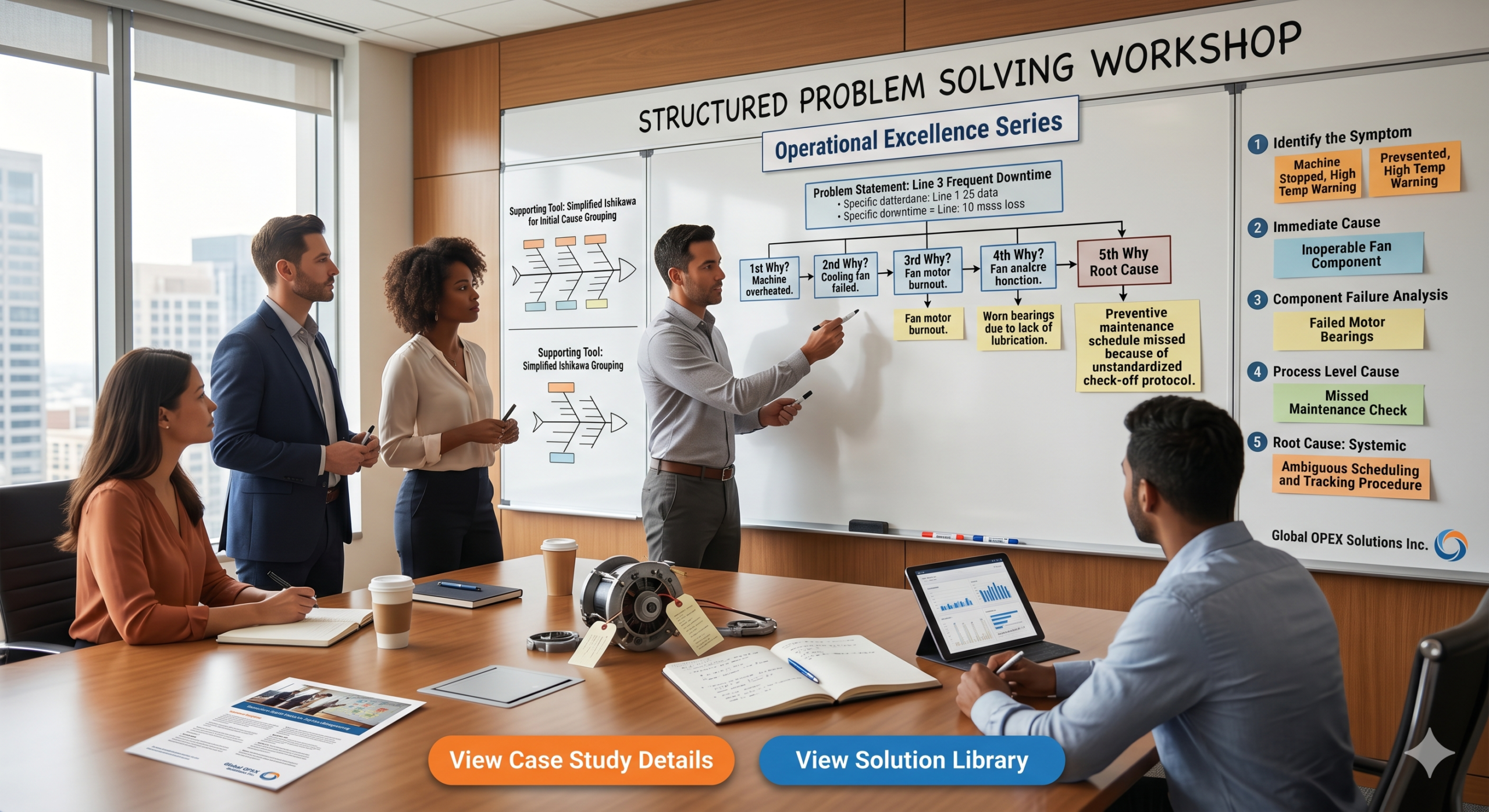
Achieving Operational Excellence requires more than reactive fixes—it demands a disciplined approach to identifying, analyzing, and resolving root causes with precision and consistency. The Structured Problem-Solving Methodologies module equips teams with proven frameworks such as PDCA, QC Story, 8D, and 6 Sima thinking to drive sustainable improvements across processes and systems.

To break this cycle, an organization must transition from reactive containment to proactive resolution by embedding Systematic Problem Solving into its DNA. Learning structured techniques—such as QC Story, the 8D (Eight Disciplines) methodology, and Six Sigma DMAIC—provides teams with a universal, step-by-step roadmap.

These frameworks ensure that problems are accurately defined, immediate containment is established to protect the customer, and rigorous Root Cause Analysis (RCA) is conducted before any long-term changes are made. Furthermore, deploying these structured methodologies is a mandatory requirement for compliance with rigorous global Quality Management Systems (QMS) such as ISO 9001, AS9100, and IATF 16949.


Methodology

This methodology synthesizes principles from authoritative Quality Management frameworks, including:

Lean Methodology

Developed via the Toyota Production System (TPS). Lean focuses on the relentless elimination of waste (Muda), unevenness (Mura), and overburden (Muri) within a system. In the context of RCA, Lean methodologies prioritize speed, workflow efficiency, and empowering frontline workers to "stop the line" (Jidoka) and solve problems at their source. Tools derived from Lean (such as 5 Whys, ECRS, and Poka-Yoke) are designed to be highly accessible and focused on designing foolproof processes that maximize customer value.

QC Story

Pioneered by Kaoru Ishikawa (creator of the 7 QC Tools). TQM is a holistic management approach that focuses on continuous improvement and involves all employees, from top management to the shop floor. In the context of RCA, TQM relies heavily on Quality Circles—small groups of frontline workers who meet regularly to identify, analyze, and solve work-related problems. Ishikawa's core philosophy was to democratize data analysis; he believed that 95% of a company's problems could be solved using simple visual tools, empowering frontline staff to perform RCA rather than relying solely on specialized engineers.

8D Problem Solving

Originally developed by the Ford Motor Company, 8D is a team-oriented framework standard in the automotive and complex manufacturing industries. It dictates an 8-step rigorous process (from D1 to D8) that emphasizes immediate containment of the problem to protect the customer, followed by deep root cause analysis (using tools like 5 Whys and Fishbone) to implement permanent, systemic corrective and preventive actions.

6 Sigma Breakthrough

Pioneered by Motorola and popularized by General Electric, this is a highly disciplined, data-driven quality strategy. It relies heavily on strict statistical methods to identify and remove the causes of defects and minimize variability in manufacturing and business processes. In the context of RCA, Six Sigma aims for mathematical near-perfection—specifically, a process must not produce more than 3.4 defects per million opportunities (DPMO). It utilizes a structured project management hierarchy (the "Belt" system, from Green Belts to Master Black Belts) to lead cross-functional teams through complex, chronic problems that simple visual tools cannot solve, relying on definitive statistical proof rather than qualitative assumptions.


Key Takeaways

By the end of the training, participants will have developed the confidence and capability to use RCA tools effectively, fostering a culture of continuous improvement and proactive problem-solving within their teams and across the organization.

Master Structured Problem-Solving Frameworks

Gain a working knowledge of leading methodologies. These frameworks empower teams to approach problems systematically and develop effective, sustainable solutions.

Hands-On Application with Real-World Scenarios

Practical learning by working through actual workplace problems in cross-functional teams, ensuring that concepts are directly applicable to participants’ day-to-day roles

Proficiency with Problem Statement Tools

Develop skills in the effective use of tools such as 5W/1H, Is/isn't. Pareto, Check Sheet, SPC, etc. These tools help identify problem clearly.

Enhanced Critical Thinking and Data-Driven Decision Making

Through guided practice, participants will learn to base decisions on data and thorough analysis, fostering a culture of continuous improvement and proactive problem resolution.

Collaboration Across Functions

Training in cross-functional environments enhances teamwork, communication, and shared understanding, which are essential for effective problem-solving and operational excellence.


Empowerment to Drive Continuous Improvement

Capable to lead or contribute to improvement initiatives, making lasting positive impacts on quality, productivity, and workplace culture within their organizations.


Operational Excellence 4.0: SPS Integrated

OpEx 4.0 | Integrated Problem Solving Hub

Bridging Structure with Digital Intelligence

Traditional Structured Problem Solving (SPS) frameworks provide the discipline. Industry 4.0 provides the real-time data and cognitive capabilities. Together, they shift operations from Reactive Correction to Predictive Prevention. Explore how digital transformation elevates operational excellence below.

Core Methodologies

Click any card to see how Industry 4.0 technologies revolutionize these established frameworks.

The Digital Integration Workflow

Follow the problem-solving lifecycle. Select a phase to see the digital intervention.

1. Define Phase

Traditional Approach

Manual problem description based on operator reports and lagging indicators (shift logs).

I4.0 Transformation

Automated pattern recognition triggers alerts. Digital Twins contextualize the failure in 3D real-time.

Key Technologies Involved

Human Resource Transformation

Select a department to view the required Re-skilling and Up-skilling roadmap.

Engineering

Focus shifts from mechanical design to cyber-physical system integration.

New Hard Skills
New Soft Skills

Infrastructure Prep

Business Value Impact

Quantifying the shift from Traditional to Integrated I4.0 Operations.

Problem Resolution Time (Hours)

Comparison based on standard complex RCA cycle.

Efficiency Trend (OEE %)

Projected improvement over 12 months post-integration.

30-50%
Reduction in Downtime
20-30%
Maintenance Cost Drop
10-20%
Quality Yield Increase

© 2026 Digital Excellence Research | Integrating SPS with Industry 4.0