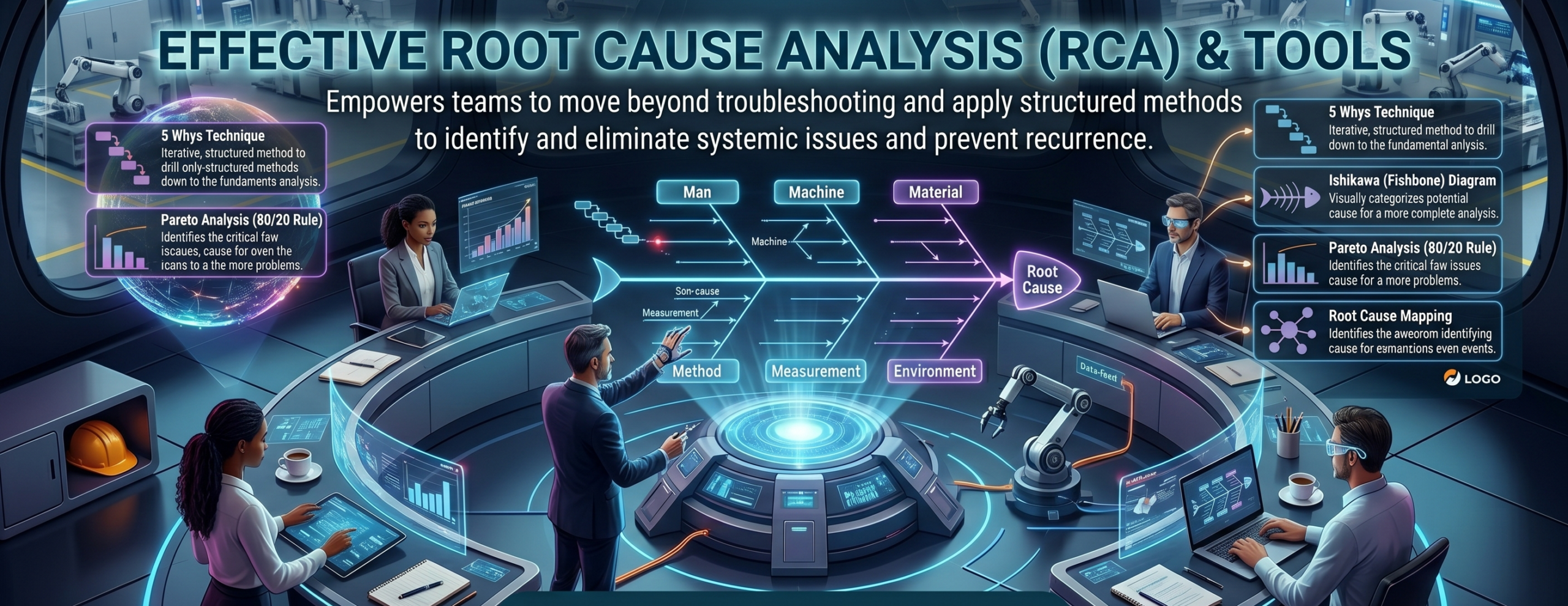
Proven Root Cause Analysis Tools
Master Problem Solving with Proven Root Cause Analysis (RCA) Tools
Are recurring operational issues, product defects, and process bottlenecks costing your business time and money?
Moving beyond reactive "firefighting" requires a systematic approach.
Root Cause Analysis (RCA) empowers teams to identify the true, underlying origin of a problem rather than just treating superficial symptoms. By mastering the right RCA methodologies, organizations can permanently eliminate waste, boost productivity, and foster a culture of continuous quality improvement.
A Comprehensive Toolkit for Every Level of Your Organization
Our RCA Essential Tools program demystifies global industry standards like Lean Manufacturing, the Toyota Production System (TPS), Total Quality Management (TQM), and Six Sigma DMAIC.
Whether you are a frontline operator utilizing the 5 Whys and 7 QC Tools (like Pareto and Fishbone diagrams), or a Quality Engineer validating data with statistical Hypothesis Testing and Design of Experiments (DoE), this curriculum equips you with the exact framework needed to define, analyze, solve, and sustain quality improvements.
RCA Tools
This training module explores proven RCA tools utilized globally in Quality Control Story, Lean, and Six Sigma frameworks.
Participants
This training is highly scalable and recommended for cross-functional professionals across manufacturing, operations, IT, and service sectors, including:
Front-Line Operators & Technicians: Seeking to utilize visual tools (Check Sheets, 5 Whys, ECRS) for immediate, shop-floor problem solving.
Team Leads & Supervisors: Responsible for guiding Quality Circles, framing problems with 5W1H, and prioritizing actions using Pareto Charts and Fishbone diagrams.
Quality Assurance & Continuous Improvement Staff: Quality Engineers, Six Sigma Yellow/Green Belts, and Process Managers tasked with leading complex 8D or DMAIC projects, utilizing advanced tools like MSA, FMEA, and Control Charts.
Operations & Plant Managers: Looking to establish a top-down culture of proactive risk mitigation and data-driven decision making.
Learning Outcomes
Upon completion of this program, participants will be able to:
Objectively Define Problems: Formulate fact-based problem statements using the 5W1H and Is/Is Not frameworks without jumping to premature conclusions.
Master the 7 QC Tools: Graphically analyze and stratify raw data using Histograms, Scatter Diagrams, and Pareto Charts to isolate critical process variations.
Trace Complex Failures: Systematically drill down to systemic origins using iterative 5 Whys, Cause-and-Effect (Fishbone) mapping, and Fault Tree Analysis (FTA).
Implement Mistake-Proofing: Design robust, permanent countermeasures utilizing Lean principles like ECRS and Poka-Yoke to ensure zero-defect sustainability.
Apply Structured Frameworks: Seamlessly integrate the appropriate RCA tools into globally recognized workflows, including the QC Story, 8D Methodology, and the Six Sigma DMAIC lifecycle.