Maintenance excellence

Maintenance Excellence TPM & RCM
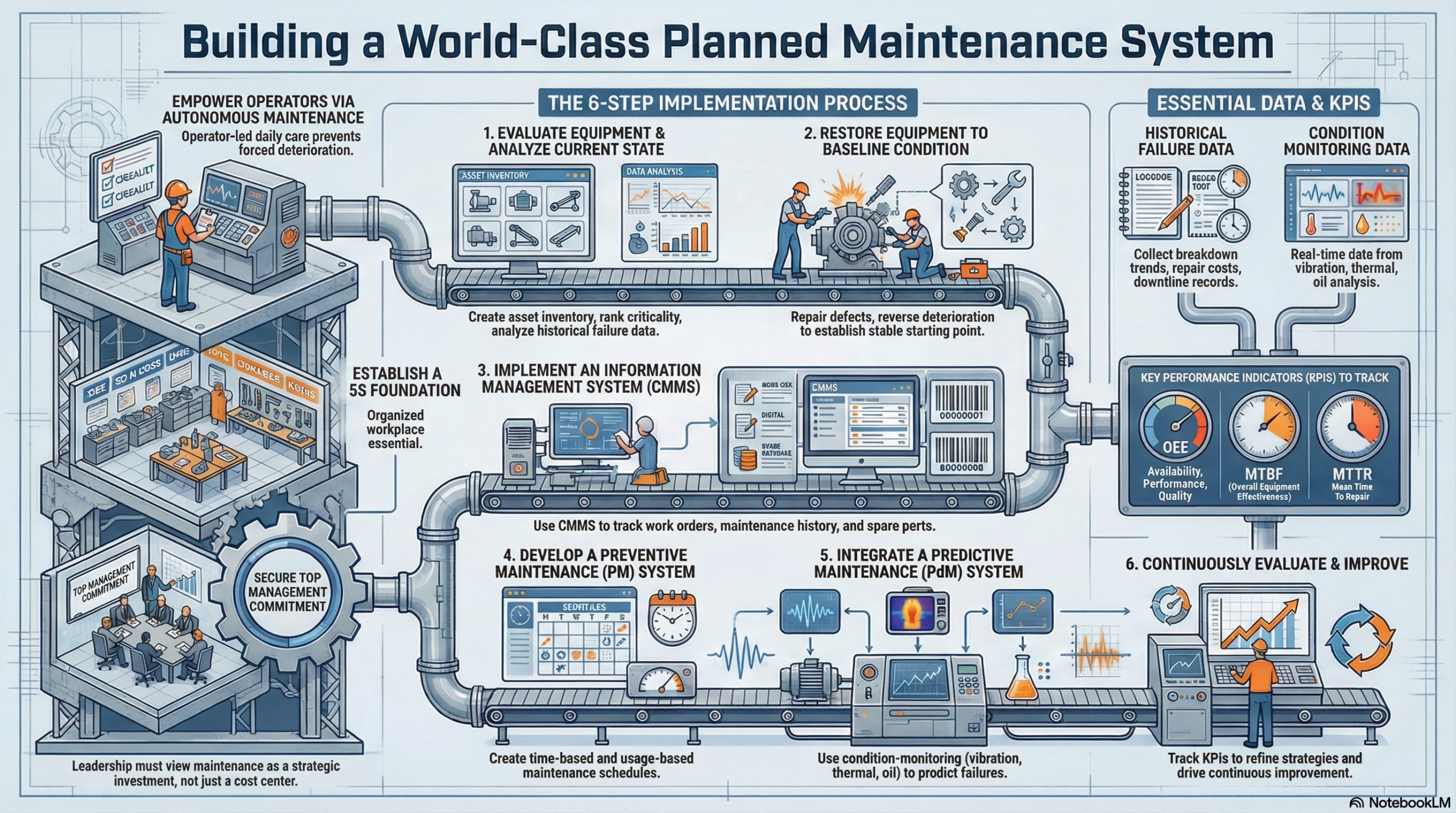
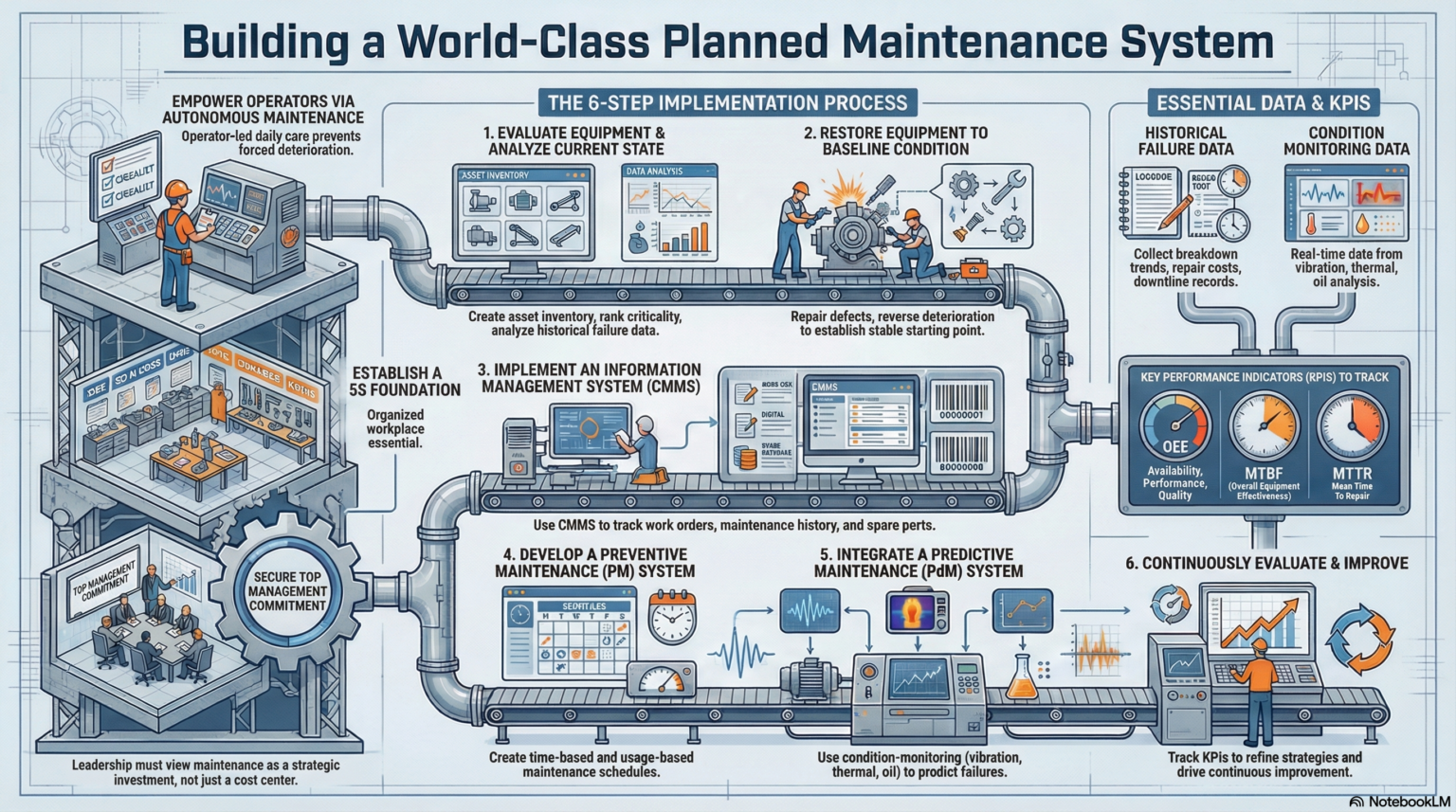
In high-performance manufacturing environments, equipment reliability and uptime are critical drivers of operational success. The Maintenance Excellence training module integrates the structured discipline of Total Productive Maintenance (TPM) with the strategic rigor of Reliability-Centered Maintenance (RCM) to build a proactive, resilient maintenance culture.

This approach empowers organizations to reduce unplanned downtime, extend asset life, and optimize maintenance resources while engaging both technicians and operators in the pursuit of excellence.

Total Productive Maintenance (TPM)

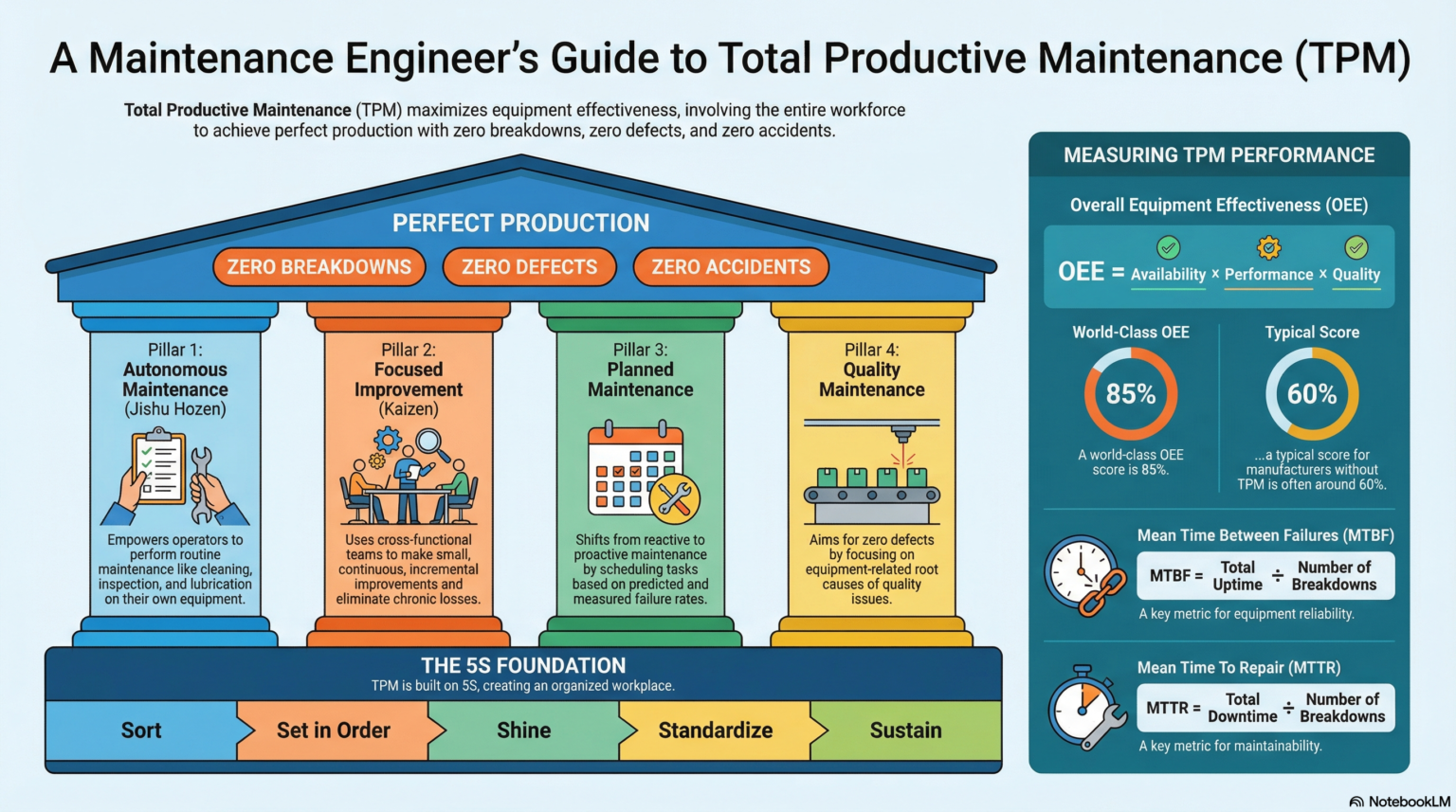
A holistic management philosophy designed to maximize equipment effectiveness throughout its entire lifecycle. Unlike traditional maintenance, which is often reactive, TPM empowers every employee—from operators to executives—to take ownership of equipment reliability. By integrating proactive and preventative maintenance into daily operations, TPM seeks to achieve "zero accidents, zero defects, and zero breakdowns," ultimately transforming equipment maintenance from a back-office chore into a strategic competitive advantage.Type your paragraph here


The Maintenance Cost

The True Cost of Unplanned Downtime

Unplanned downtime is one of the most significant "hidden" profit killers in manufacturing. It extends far beyond the immediate cost of lost production hours. The true financial impact includes expensive emergency repairs, overtime labor costs, expedited shipping fees for spare parts, and the loss of customer goodwill due to missed delivery deadlines. When an asset stops unexpectedly, the ripple effect disrupts the entire supply chain, making the true cost of downtime often 3x to 5x higher than the visible maintenance repair bill.


The Hidden Costs of Poor Quality

Poor quality—manifesting as rework, scrap, and warranty claims—creates a significant drag on operational profitability. Beyond the direct material and labor waste, poor quality erodes market reputation and increases inspection overhead. Often, these costs remain "hidden" because they are buried in general operating expenses rather than being tracked against specific equipment performance. Implementing rigorous quality controls within your maintenance program ensures that machines are running to specification, drastically reducing the waste associated with non-conforming products.


Want to Stop the Cycle of Reactive Maintenance?

Transitioning from fire-fighting to World-Class Maintenance doesn't happen overnight, but it starts with the right roadmap.

We have compiled our decades of experience into an Ultimate TPM Implementation

This training breaks down exactly how to improve your current equipment health, engage your operators, and track the metrics that actually move the needle on your bottom line.
Identify your hidden production bottlenecks.
Standardize your autonomous maintenance tasks.
Calculate the ROI of your TPM transition.

You’ll discover how to:
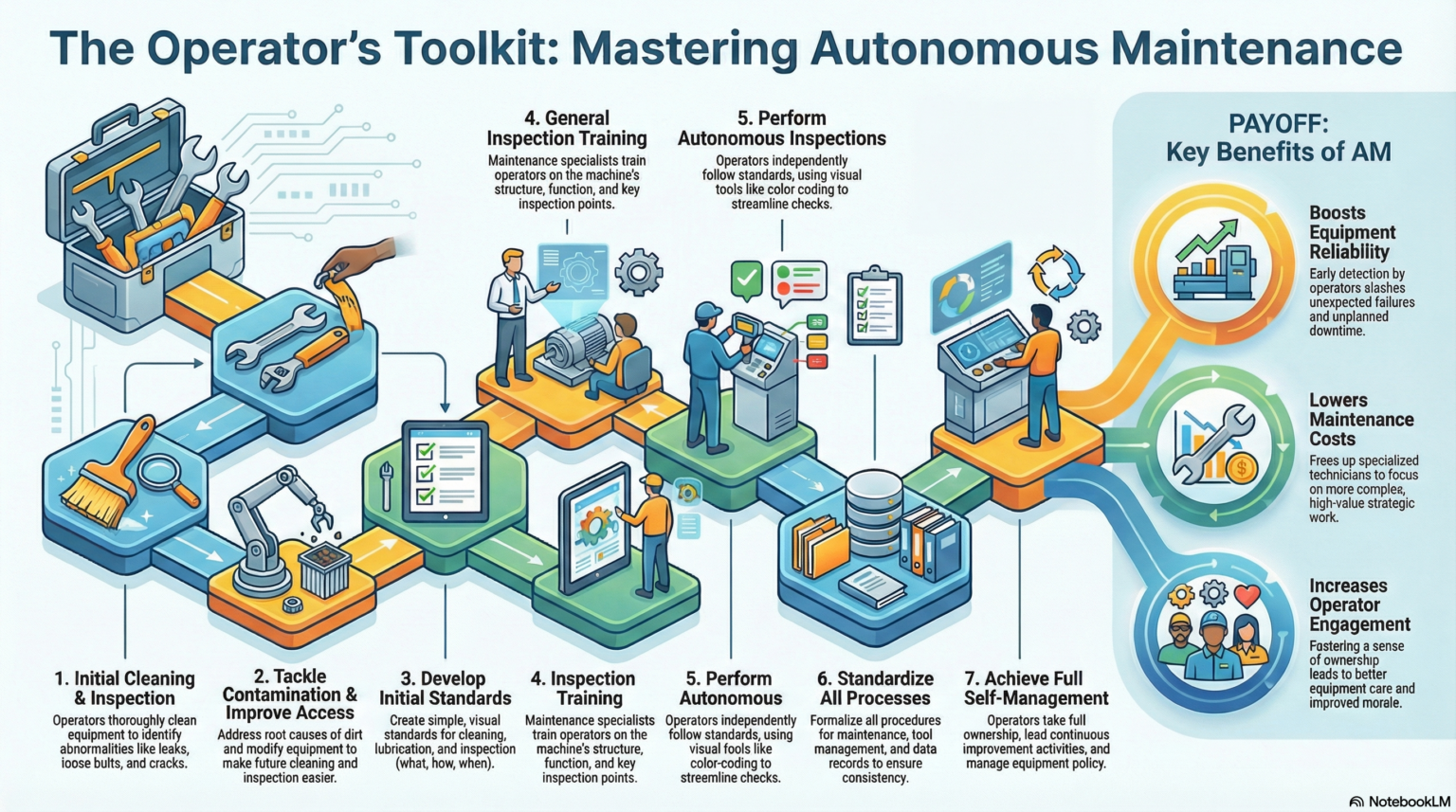
Launch Autonomous Maintenance: A step-by-step guide to empowering your operators to own their equipment.
Master the 8 Pillars: Clear, actionable criteria for each pillar, from Focused Improvement to Early Equipment Management.
Measure Success: The key performance indicators (KPIs) you need to track to prove your ROI to leadership.
Sustain Momentum: How to move beyond the "initial excitement" and embed TPM into your company culture for the long term.


Why Operations Must Focus on TPM ?

In an era of lean manufacturing, operations teams cannot afford to treat maintenance as an isolated department. A focus on TPM shifts the culture from "I operate, you fix" to shared responsibility for asset health. By involving operators in autonomous maintenance—such as cleaning, lubrication, and basic inspection—operations gain a deeper understanding of machine behavior. This collaborative approach minimizes bottlenecks, optimizes production flow, and ensures that the facility operates at peak capacity, directly impacting the bottom line.


The Pursuit of Operational Excellence

Operational Excellence (OpEx) is the relentless pursuit of high-performance processes that deliver consistent, value-added results. TPM serves as the foundational pillar for any OpEx journey. By stabilizing equipment performance and eliminating waste (Muda), organizations create the reliability required to sustain continuous improvement efforts. Without a robust maintenance strategy, your OpEx initiatives—such as Six Sigma or Lean—will struggle to gain traction because the underlying production system remains inherently unstable.   


The 8 Pillars of TPM

The success of a Total Productive Maintenance program relies on eight core pillars designed to drive continuous improvement and eliminate production losses
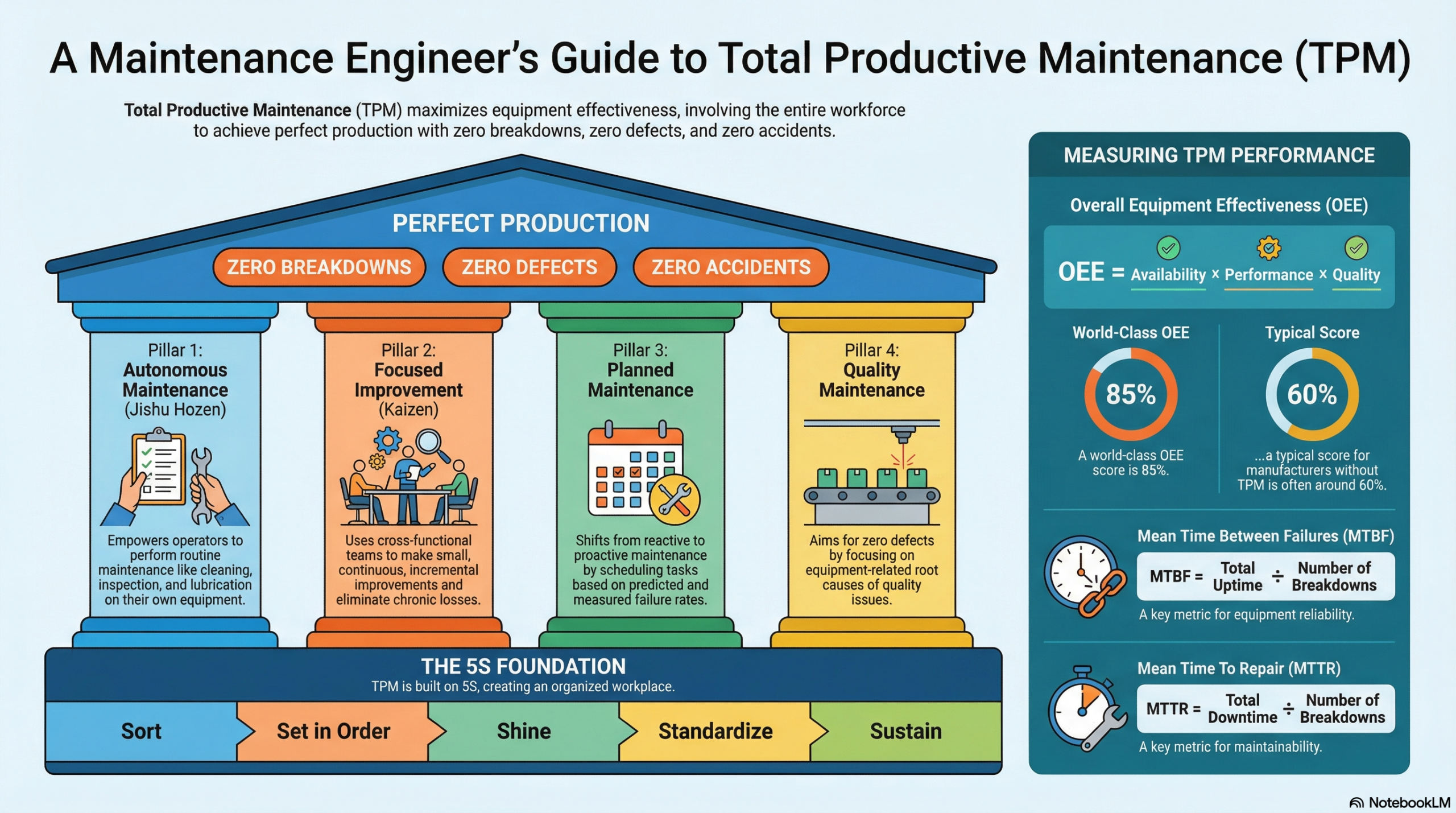
Autonomous Maintenance: Empowering operators to maintain their own equipment.
Focused Improvement (Kobetsu Kaizen): Small, cross-functional team projects to address recurring issues.
Planned Maintenance: Scheduling tasks based on observed behavior to prevent failure.
Quality Maintenance: Aligning equipment conditions with quality requirements.
Education and Training: Upgrading the skills of all personnel.
Office TPM: Streamlining administrative processes to support the shop floor.
Safety, Health, and Environment: Maintaining a risk-free, sustainable workplace.
Early Equipment Management: Designing new assets with maintainability and reliability in mind.


Understanding Overall Equipment Effectiveness (OEE)

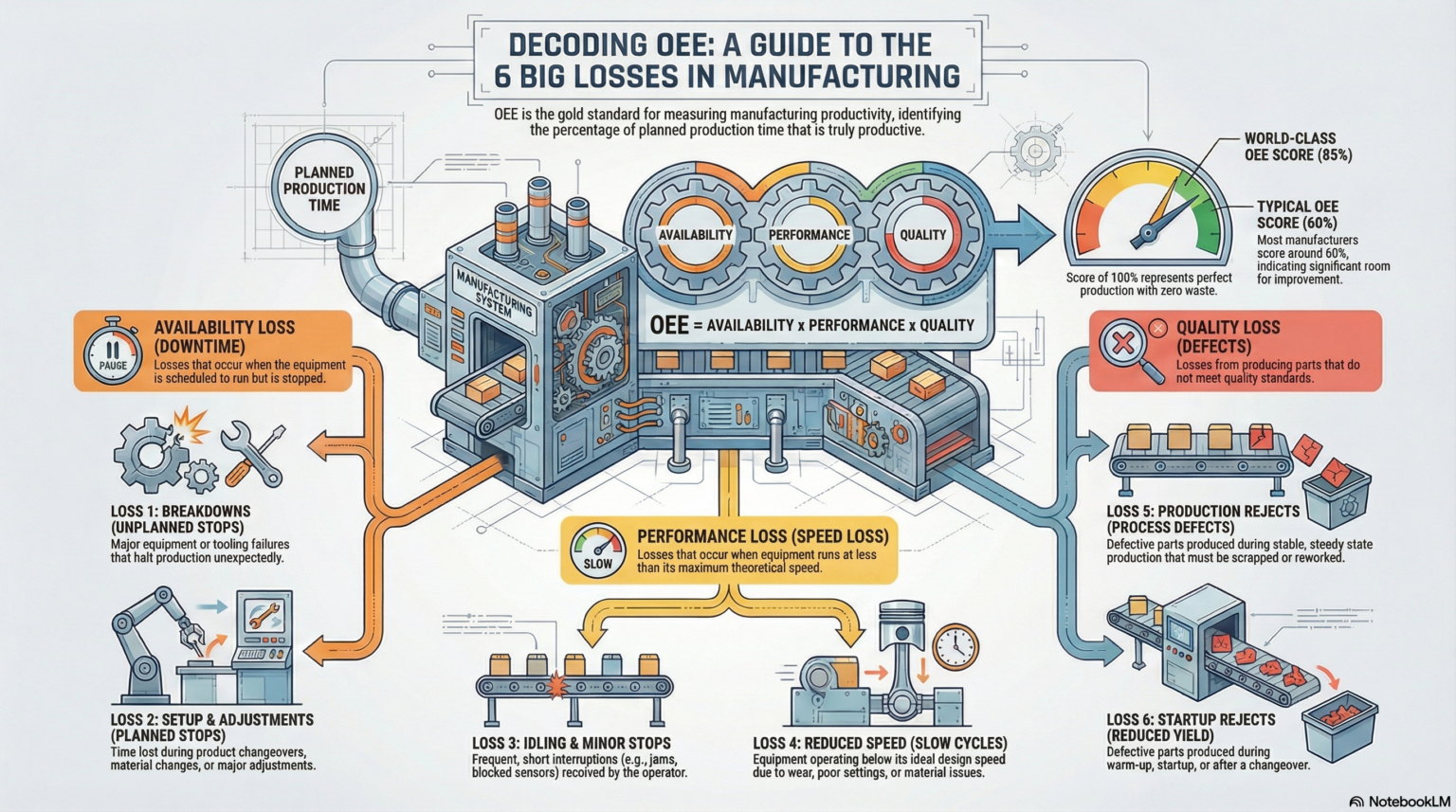
Overall Equipment Effectiveness (OEE) is the gold-standard metric for measuring manufacturing productivity. By multiplying Availability, Performance, and Quality, OEE provides a single percentage that reveals how effectively your equipment is utilized compared to its theoretical maximum potential. A world-class OEE score typically benchmarks at 85%, helping manufacturers look past simple volume output to identify the exact efficiency gaps within their production processes.

Tackling the 6 Big Losses

The "6 Big Losses" represent the most common obstacles to achieving peak OEE, and addressing them is fundamental to any Lean transformation. These losses are categorized into three areas

Availability Losses

Breakdowns: Unplanned equipment failures that halt production.
Setup and Adjustments: Downtime caused by changeovers or maintenance preparations.

Performance Losses

Small Stops: Minor interruptions, such as sensor errors or jammed parts, that do not require formal maintenance.
Reduced Speed: Operating equipment below its designed cycle time due to wear or suboptimal settings.

Quality Losses

Startup Rejects: Defective parts produced during the early stages of a production run.
Production Rejects: Quality issues and scrap generated during steady-state operation.

By systematically identifying and mitigating these six losses, teams can move from reactive troubleshooting to proactive operational improvement, ensuring that every minute of machine time adds value to the product.


Participants

  • Production Managers and Supervisors: Responsible for overseeing manufacturing operations, implementing process improvements, and driving productivity and quality initiatives.
  • Process Engineers: Involved in designing, analyzing, and optimizing manufacturing processes; key players in Lean and Six Sigma project execution.
  • Maintenance Managers and Technicians: Essential for implementing Total Productive Maintenance (TPM), Reliability-Centered Maintenance (RCM), and ensuring equipment reliability and operational efficiency.
  • Quality Assurance and Quality Control Personnel: Tasked with monitoring product quality, conducting root cause analysis, and applying statistical process control (SPC) techniques.
  • Continuous Improvement (CI) Specialists: Champions of ongoing improvement initiatives, cross-functional collaboration, and data-driven decision-making.
  • Operators and Line Leaders: Directly involved in day-to-day manufacturing activities, critical for hands-on learning, autonomous maintenance, and real-time process monitoring.
  • Supply Chain and Logistics Professionals: Those who collaborate on process improvement projects that impact material flow, inventory management, and overall operational performance.

Training Topics

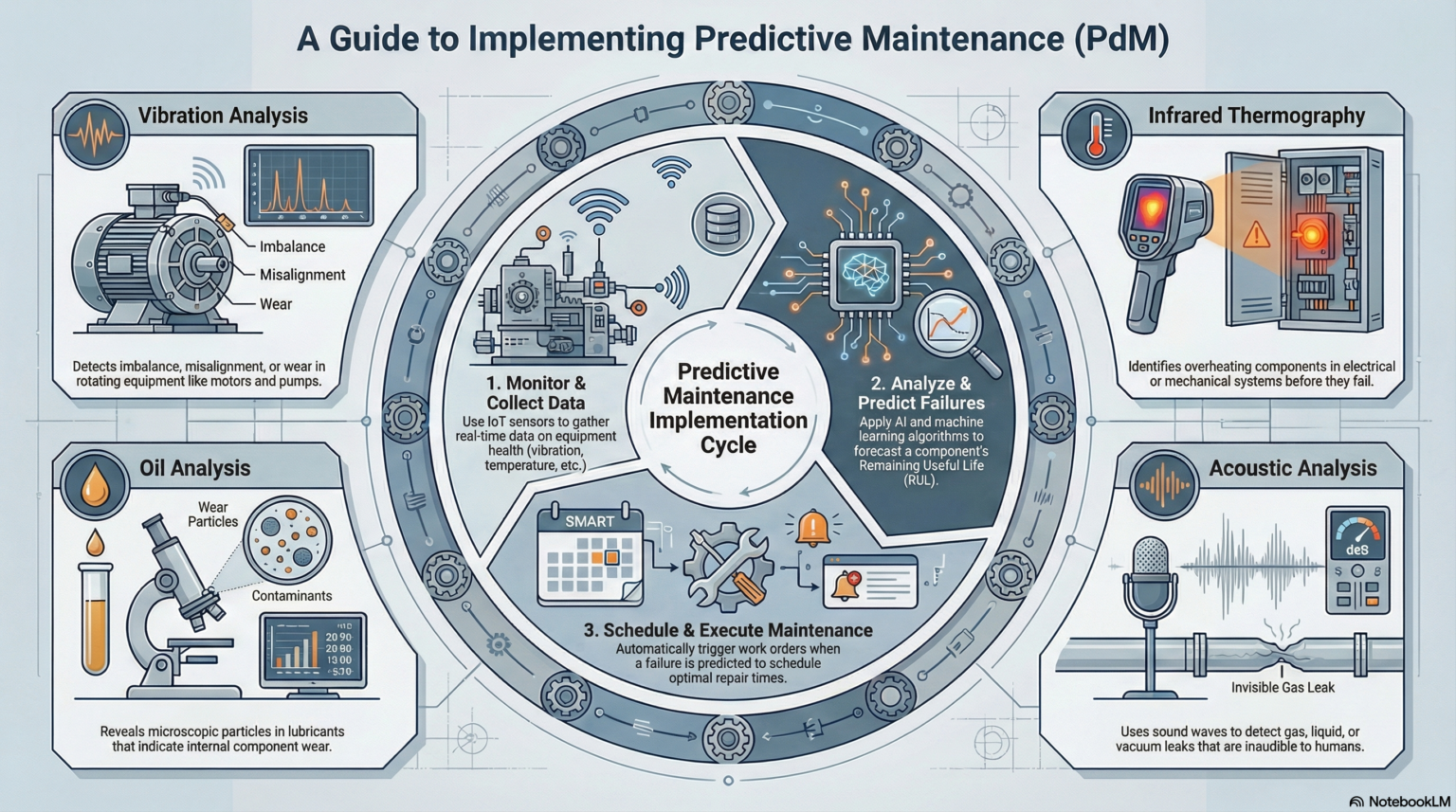
Here is a structured, tiered training curriculum for Total Productive Maintenance (TPM). To ensure a successful rollout, the topics are segmented into three distinct certification tracks, aligning the depth of technical knowledge with the specific roles responsible for execution on the shop floor.
Target Participants: Machine Operators, Production Associates, and Line Team Leaders.
Objective: Shift the culture from "I operate, you fix" to shared equipment ownership and frontline abnormality detection.

Module 1.1: TPM Foundations & The 3 Zeros
Defining the goals: Zero Breakdowns, Zero Defects, and Zero Accidents.
Understanding the difference between reactive and proactive maintenance.
Module 1.2: The 8 Wastes of Lean Operations
Identifying operational inefficiencies using the TIMWOODS framework (Transport, Inventory, Motion, Waiting, Overproduction, Overprocessing, Defects, Skills) specific to equipment constraints.
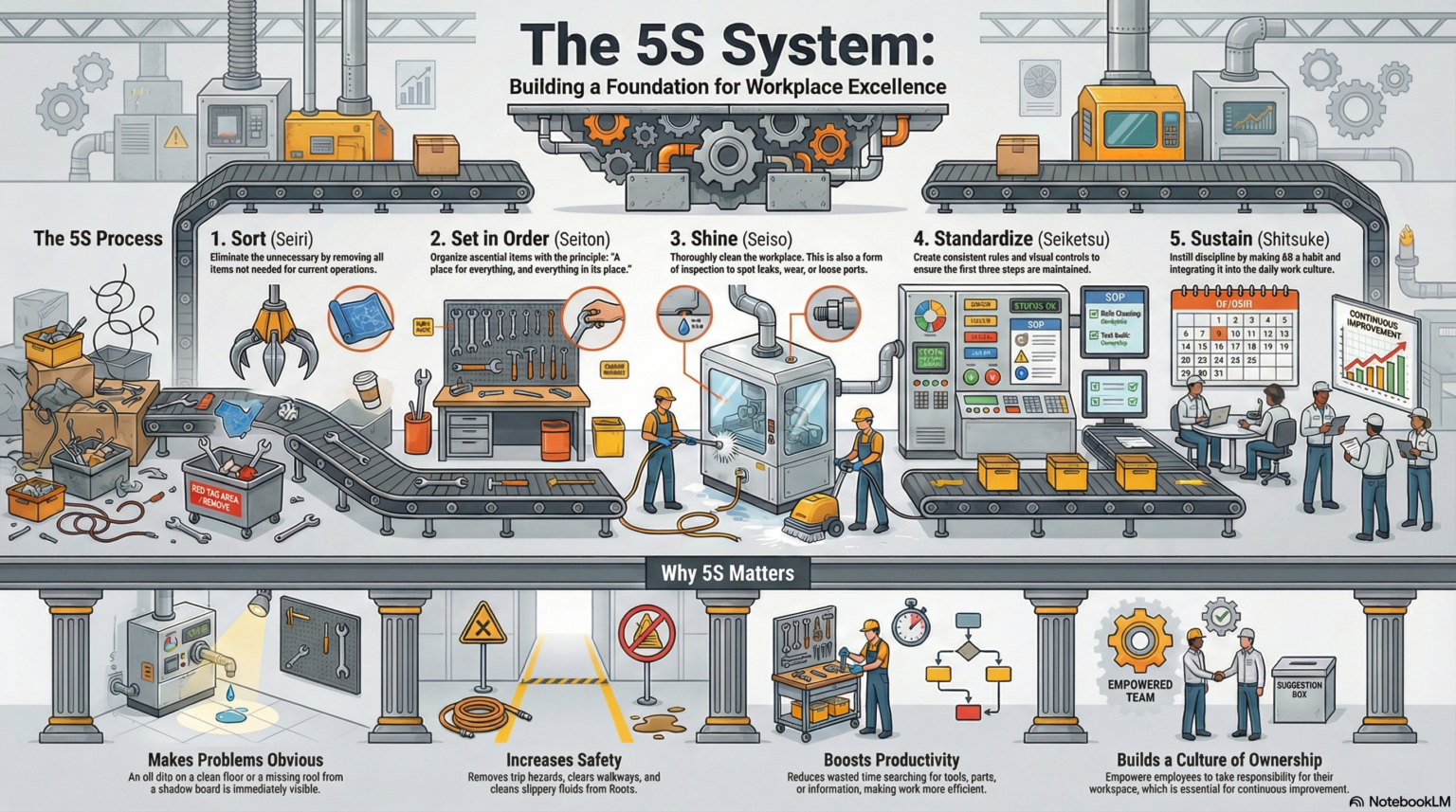
Module 1.3: 5S & The Visual Workplace
Applying Sort, Set in Order, Shine, Standardize, and Sustain to machine centers.
Creating visual shadow boards and localized tool management.
Module 1.4: Autonomous Maintenance (Jishu Hozen) Steps 1-3
Cleaning as a form of inspection.Locating and eliminating sources of contamination.Executing CIL (Cleaning, Inspection, Lubrication) standards.
Module 1.5: One-Point Lessons (OPL)
How to read, write, and train peers using highly visual, single-page work standards.

Target Participants: Maintenance Technicians, Maintenance Supervisors, and Reliability Specialists.
Objective: Transition from time-based parts replacement to root-cause elimination and predictive care.

Module 2.1: Planned Maintenance Optimization
Structuring time-based, usage-based, and condition-based maintenance schedules.
Spare parts inventory control and MRO (Maintenance, Repair, and Operations) management.
Module 2.2: Root Cause Analysis (RCA) for Chronic Failures
Applying the 5 Whys and Ishikawa (Fishbone) diagrams to equipment breakdowns.
Introduction to PM Analysis for complex, recurring micro-stops.
Module 2.3: Quality Maintenance (Hinshitsu Hozen)
Understanding the relationship between machine tolerances and product defects.
Implementing Poka-Yoke (mistake-proofing) mechanisms on existing equipment.
Module 2.4: Predictive Technologies & Condition Monitoring
Interpreting baseline data from vibration analysis, thermography, and ultrasonic testing.
Module 2.5: Operator Coaching & Mentorship
Developing the soft skills required to train machine operators on safe Autonomous Maintenance handoffs.

Target Participants: Process Engineers, Quality Engineers, Product Engineers, and Plant Leadership/Managers.
Objective: Design for reliability, track enterprise-wide performance, and integrate modern digital frameworks into traditional TPM.

Module 3.1: OEE Architecture & Performance Analytics
Defining, calculating, and deploying Overall Equipment Effectiveness (OEE) metrics.Categorizing and quantifying the Six Big Losses.
Module 3.2: Early Equipment Management (EEM)
Incorporating maintenance prevention into the design and procurement of new equipment.
Life Cycle Costing (LCC) and vertical startup methodologies.
Module 3.3: Focused Improvement (Kobetsu Kaizen)
Structuring and leading cross-functional teams to eliminate specific operational bottlenecks.
Applying SMED (Single-Minute Exchange of Die) to reduce changeover losses.
Module 3.4: Industry 4.0 & The Digital TPM Evolution
Upgrading legacy systems with IoT sensor networks for real-time condition monitoring.
Utilizing Digital Twin technology to simulate equipment wear and optimize maintenance routing without halting physical production.
Module 3.5: Master Planning & Change Management
Developing the 3-to-5 year TPM rollout strategy.
Overcoming cultural resistance and breaking down departmental silos between production and maintenance.


Total Productive Maintenance – Philosophy

  • 8 Pillars Foundation
  • 5S Workplace
  • 6 Big Losses 
  • TPM + Industry 4.0
  • Predictive Maintenance Readiness
  • OEE Measurement 

Discover how Total Productive Maintenance (TPM) drives Operational Excellence.
Learn the 8 pillars, improve your OEE, and eliminate manufacturing waste with proactive equipment reliability.

Total Productive Maintenance (TPM) - Interactive Research Report

Executive Summary

Shifting from Reactive to Proactive

Total Productive Maintenance (TPM) is an enterprise-wide strategy designed to maximize equipment effectiveness. By blurring the lines between production and maintenance, TPM aims to achieve "Perfect Production": Zero Breakdowns, Zero Small Stops, and Zero Defects.

The Ultimate Metric: OEE

Overall Equipment Effectiveness (OEE) is the gold standard for measuring manufacturing productivity. It exposes the hidden capacity in your plant. Adjust the sliders below to see how minor losses compound exponentially.

Availability (A) 85%

Losses: Breakdowns, Setups, Changeovers

Performance (P) 90%

Losses: Minor stops, Reduced operating speed

Quality (Q) 95%

Losses: Scrap, Rework, Startup defects

Your Facility's Current OEE

72.6% World Class = 85%+

Structural Framework

The 8 Pillars of TPM

TPM is supported by a foundational base of 5S (Sort, Set in order, Shine, Standardize, Sustain). Upon this base sit eight distinct pillars, each representing a proactive strategy. Click a pillar to explore its focus.

🧑‍🔧

Autonomous Maintenance

🔍

Focused Improvement

🗓️

Planned Maintenance

Quality Maintenance

🏗️

Early Equipment Mgmt.

🎓

Education & Training

🛡️

Health & Safety

🏢

TPM in the Office

🧑‍🔧
🧑‍🔧

Autonomous Maintenance

"Jishu Hozen". Empowers machine operators to take responsibility for routine maintenance tasks, freeing up highly skilled technicians for complex diagnostics.

Core Activities

  • Cleaning equipment as a form of inspection.
  • Routine lubrication and tightening of loose components.
  • Identifying early abnormalities before they result in failure.

Implementation Execution

Recommended Curriculum

TPM requires a cultural paradigm shift backed by hard skills. Select a role below to view the specific topics and practical training required to execute a successful TPM rollout.

👷

Operator Foundation

  • 5S & Visual Workplace

    Mastering Sort, Set, Shine, Standardize, Sustain. Creating shadow boards for tools.

  • CIL Standards

    Executing standard routes for Cleaning, Inspection, and Lubrication safely.

  • One-Point Lessons (OPL)

    How to write and read highly visual, single-page work instructions.

🔧

Technician Advanced

  • Root Cause Analysis (RCA)

    Beyond replacing parts: Using 5 Whys, Ishikawa diagrams, and PM Analysis.

  • Predictive Technologies

    Interpreting data from thermography, vibration analysis, and ultrasonic sensors.

  • Operator Coaching

    Developing soft skills to mentor operators on basic Autonomous Maintenance tasks.

📊

Leadership Strategy

  • OEE Deployment

    Establishing automated data collection and verifying the integrity of baseline metrics.

  • Change Management

    Overcoming resistance and breaking down silos between Production and Maintenance.

  • Master Planning

    Developing the 3-to-5 year TPM rollout strategy across multiple plant lines.