KPI and Performance Management
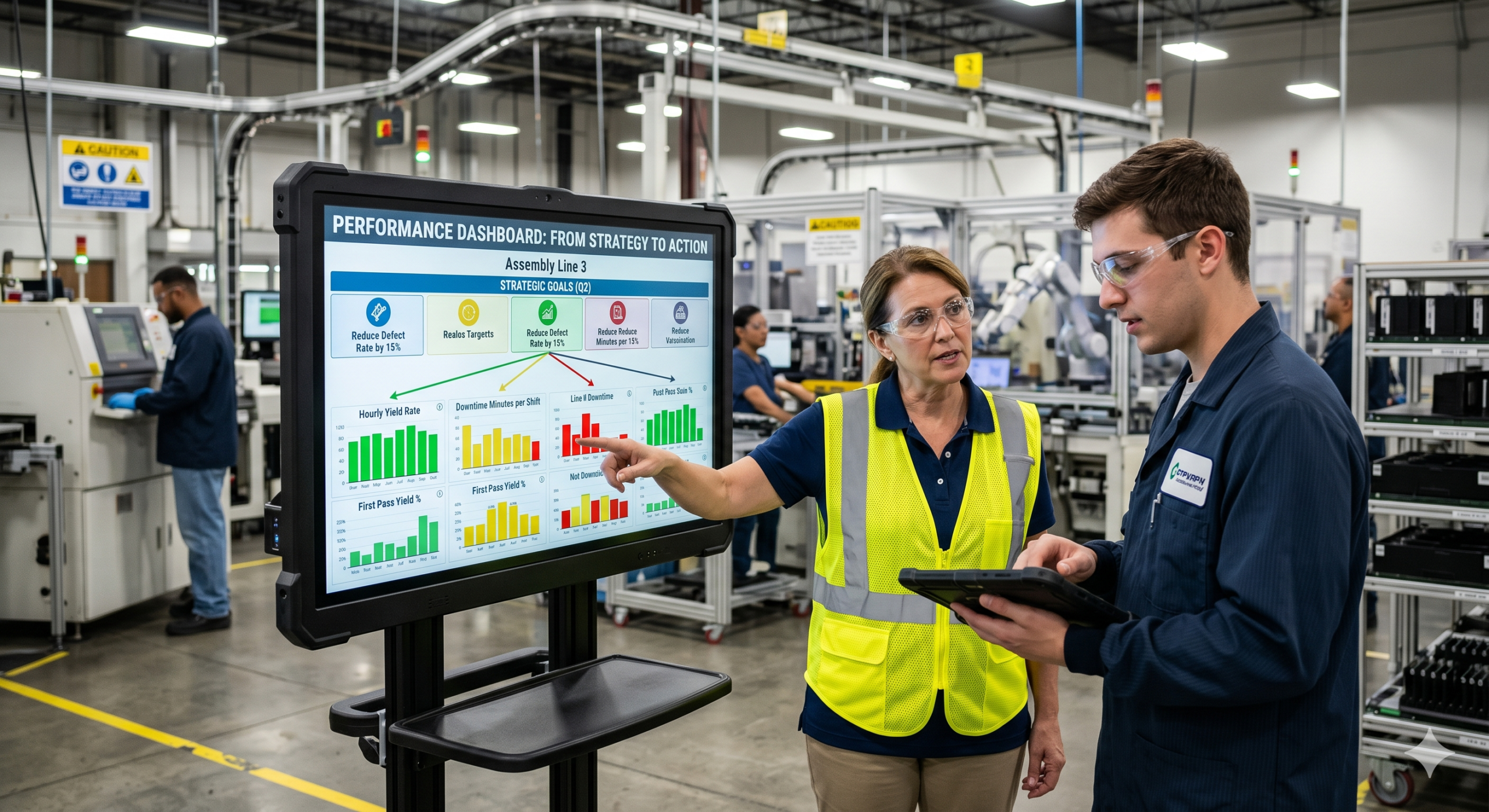
KPIs are essential tools for translating strategic goals into actionable metrics that drive operational excellence. By defining clear, measurable indicators across productivity, quality, cost, and safety, organizations can monitor performance, identify gaps, and guide continuous improvement efforts.
Effective performance management ensures that these KPIs are aligned with business objectives, regularly reviewed, and used to foster accountability and informed decision-making at all levels. When integrated into daily operations, KPIs become a catalyst for transparency, agility, and sustained excellence.
Participant
The Participants and Key takeaways for the “Key Performance Indicators (KPIs) & Performance Management” training topic are:
Operational Manager
Individuals responsible for overseeing manufacturing operations and ensuring that production targets are met.
Supervisors & Team Leaders
Frontline leaders who manage daily performance and are directly involved in tracking and improving KPIs.
Emerging Leaders
High-potential supervisors or team leads preparing for future leadership roles who need exposure to strategic planning concepts and performance management frameworks.
Key Takeaways
Selecting participants from these groups ensures the training delivers maximum impact by equipping current and future decision-makers with the knowledge and skills to design, implement, and manage effective KPIs aligned with organizational goals.
Practical KPI Frameworks
Participants will learn how to design, implement, and manage effective KPI systems tailored for manufacturing, including understanding the difference between lagging and leading indicators, and aligning metrics with strategic business goals.
Data-Driven Performance Measurement
Attendees will gain hands-on experience in collecting, analyzing, and utilizing performance data using visual management dashboards, with actionable examples for OEE, first-pass yield, cycle time, scrap rate, energy consumption, and safety metrics.
SMART Criteria Application
The training will equip participants with tools to define KPIs using the SMART (Specific, Measurable, Achievable, Relevant, Time-bound) criteria, ensuring clarity and relevance of performance measures
Effective Review and Feedback Processes
Managers and supervisors will learn best practices for conducting regular performance reviews, providing constructive feedback, and linking individual and team achievements to organizational objectives.
Alignment with Strategy
Participants will understand how to ensure KPIs directly support broader business strategies and operational goals, fostering a culture of continuous improvement and accountability.
Leadership and Coaching Skills
The training will develop participants’ abilities to coach teams, drive engagement, and promote a results-oriented mindset throughout the organization.
By participating in this training, operational managers, supervisors, team leaders, and emerging leaders will be equipped with the knowledge and skills to design, implement, and manage effective KPIs that drive manufacturing excellence and align performance management with business objectives.
Coaching Focuses
- Understanding different types of KPIs (lagging vs. leading, process vs. outcome).
- Applying SMART criteria (Specific, Measurable, Achievable, Relevant, Time-bound) for KPI definition.
- Aligning KPIs with strategic objectives and operational goals.
- Data collection, analysis, and measurement techniques for KPIs.
- Utilizing visual management dashboards.
- Through interactive workshops, participants practice aligning KPIs to business outcomes and operational targets.
- Hands-on exercises focus on developing and implementing a robust KPI framework.
Strategic Performance Management and Industry 4.0
Bridging the Gap:
KPIs in the Age of Industry 4.0
A comprehensive research synthesis on transforming traditional Performance Management into a real-time, data-driven Operational Excellence engine.
Performance Management
Moving from retrospective monthly reports to proactive, real-time decision making through cascade deployment.
Industry 4.0 Integration
Leveraging IoT, Big Data, and AI to automate data collection and provide granular insights at the machine level.
Human Capital
Reskilling management and front-line operators to interpret digital dashboards and act on predictive indicators.
Foundations of Performance Management
Before integration, the core principles of measurement must be solid. This section covers the bedrock of organizational alignment.
What is a KPI?
A Key Performance Indicator (KPI) is a quantifiable measure used to evaluate the success of an organization, employee, etc., in meeting objectives for performance.
Key Characteristic
KPIs must be actionable. If a metric changes and no one knows what action to take, it is a vanity metric, not a KPI.
S.M.A.R.T. Goals Framework
Click each letter to understand the criteria.
The Balanced Scorecard (BSC)
A strategic management performance metric that helps companies identify and improve their internal operations to help their external outcomes. It measures past performance data and provides feedback on how to make better decisions in the future.
- Financial: "To succeed financially, how should we appear to our shareholders?"
- Customer: "To achieve our vision, how should we appear to our customers?"
- Internal Process: "To satisfy our shareholders and customers, at what business processes must we excel?"
- Learning & Growth: "To achieve our vision, how will we sustain our ability to change and improve?"
Alignment via Cascade Deployment
Cascading is the process of translating top-level organizational strategy into lower-level tactical and operational goals. This ensures that the front-line operator's daily tasks directly contribute to the CEO's vision.
Level 1: Corporate Strategy
"Increase Market Share by 15%"
Level 2: Department Goals (Production)
"Reduce Manufacturing Lead Time by 20%"
Level 3: Team Objectives (Line A)
"Improve OEE (Overall Equipment Effectiveness) to 85%"
Level 4: Individual KPI (Operator)
"Maintain machine availability > 95% via preventative checks"
Industry 4.0 Integration
The core of the research: How digital technologies transform static performance management into a dynamic, predictive ecosystem.
The Digital Data Pipeline
1. IoT Sensors
Vibration, Temp, Speed
2. Connectivity
Edge/Cloud Gateway
3. Aggregation
Big Data Lake
4. AI Analysis
Pattern Recognition
5. Actionable KPI
Real-time Dashboard
Highlight: Breaking the Silo
Traditional PM often fails because data is trapped in department-specific Excel sheets. I4.0 creates a "Single Source of Truth."
The Shift: Reactive vs. Predictive
The "Break-Fix" Cycle
1. Machine Bearing overheats.
2. Machine fails at 2:00 PM.
3. Line stops. Manager called.
4. Maintenance diagnosed at 3:00 PM.
Result: 4 Hours Downtime. KPI Impact: Missed.
The "Predictive" Cycle
1. IoT Sensor detects vibration anomaly (Trend > 5%).
2. AI predicts failure in 48 hours.
3. Auto-ticket generated for maintenance during planned changeover.
4. Part replaced before failure.
Result: 0 Unplanned Downtime. KPI: Exceeded.
Preparation & Reskilling
Technology is only 20% of the challenge. 80% is people and process. What is required to succeed?
Required Infrastructure
Hardware Layer
Smart Sensors (Vibration, Temp), Edge Gateways, Tablets/HMI for operators.
Software Layer
Cloud Platform (AWS/Azure), MES (Manufacturing Execution System), Dashboarding (PowerBI/Tableau).
Security
OT/IT convergence security protocols to protect proprietary production data.
Human Capital: Reskilling Matrix
Select a role to see how I4.0 changes their responsibilities and required skills.
Management Team
Strategic Decision Makers
Relying on "gut feeling" and monthly lagging reports. Managing people via attendance and manual logs.
Data Literacy: Ability to interpret complex dashboards. Agility: Pivoting strategy based on real-time market/production data. Trusting the algorithm.
Value & Bottom Line
The ultimate goal: Operational Excellence translating to Customer Value and Profitability.
Operational Excellence
15-20%
Increase in OEE (Overall Equipment Effectiveness)
Maintenance Costs
30%
Reduction via Predictive Maintenance
Customer Value
On-Time
Higher delivery precision & Quality Assurance
Benefit Trajectory: Traditional vs. I4.0 Integrated
Projected impact on "Bottom Line" (Net Profit Margin) over 5 years of transformation.