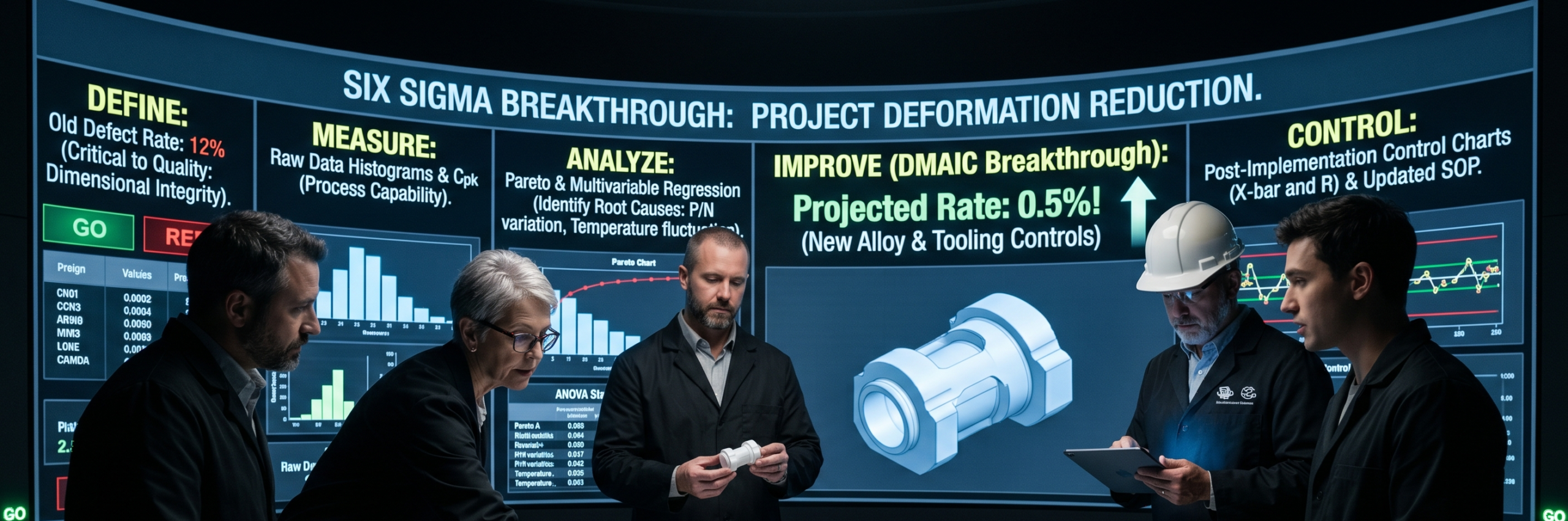
Six Sigma: Breakthrough Strategy

Six Sigma: Breakthrough Strategy

Six Sigma is a data-driven methodology aimed at reducing process variation and improving quality across all facets of manufacturing and business operations.

This training module provides a comprehensive pathway for professionals to become certified Six Sigma Green Belts and Black Belts, equipping them with the analytical skills and leadership capabilities needed to drive continuous improvement.

"The Six Sigma Breakthrough Strategy" is the premier methodology for organizations seeking to eliminate chronic operational defects and drive massive financial returns. By leveraging the structured DMAIC framework—Define, Measure, Analyze, Improve, Control—companies can move past incremental Kaizen improvements and achieve exponential leaps in process capability.

Discover how mastering statistical problem-solving and root cause analysis can transform both manufacturing floors and complex supply chain networks."

By mastering Six Sigma principles, participants will be able to identify root causes of defects, optimize processes, and deliver measurable gains in efficiency, customer satisfaction, and cost reduction.
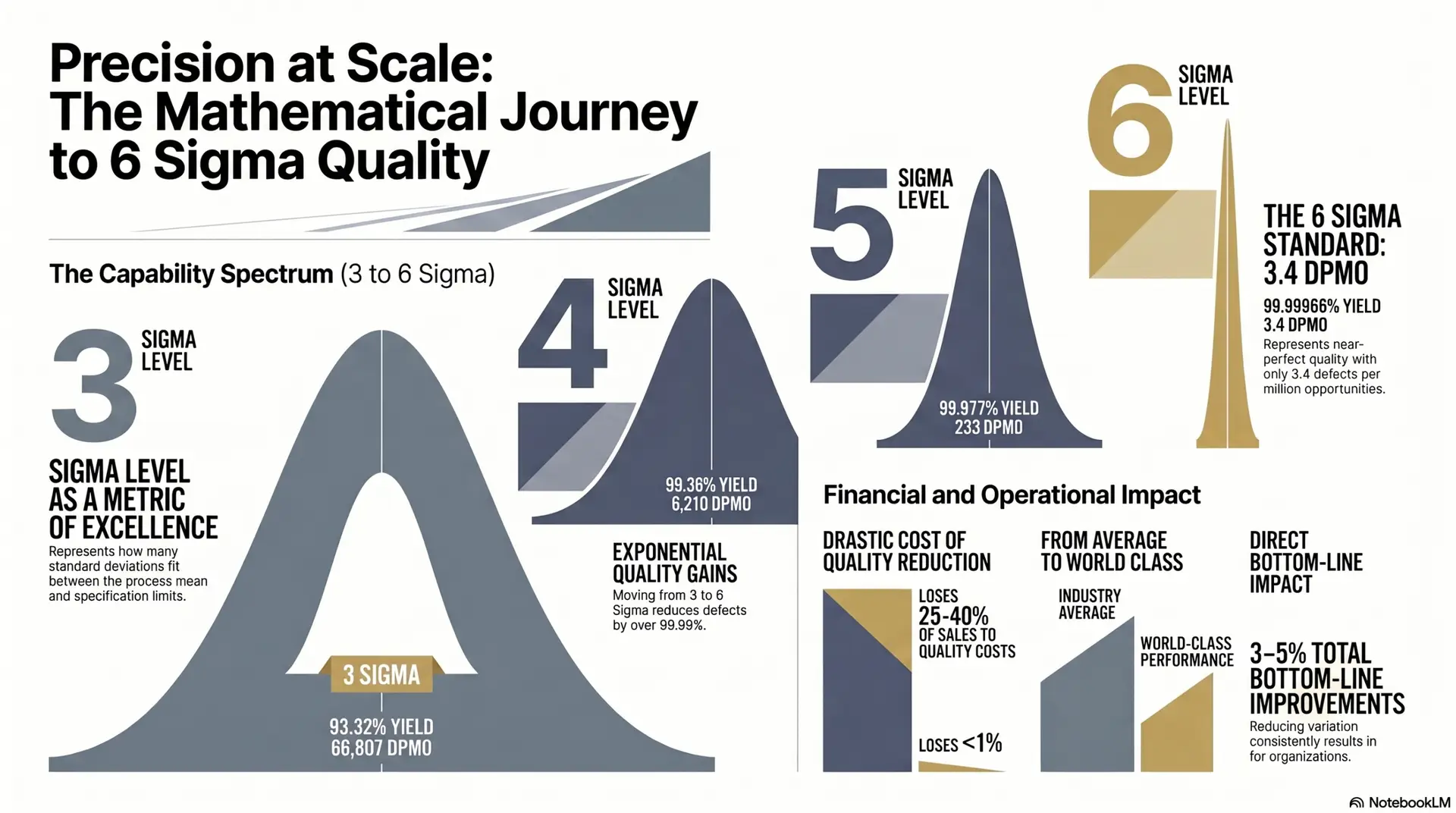

Long-Term Process Capability

Long-term process capability improvement focuses on reducing variation and enhancing consistency over time to ensure outputs reliably meet customer specifications. by applying statistical tools like Cp, Cpk, and control charts, organizations can monitor trends, identify shifts, and sustain high-quality performance through continuous refinement.

"Achieve Operational Breakthroughs"

DMAIC Framework in Operational Excellence

"Achieving Operational Excellence requires more than just process mapping; it requires the mathematical rigor of the DMAIC framework.
As a core pillar of the Six Sigma Breakthrough Strategy, DMAIC empowers Green Belts and Black Belts to isolate the hidden variables (x's) that cause quality failures (Y).
By integrating modern Quality 4.0 technologies with classic statistical tools, industry leaders are setting new benchmarks for efficiency and defect reduction."


Training Focuses

At the end of the training, participants will be certified and ready to lead data-driven excellence initiatives with confidence and impact, focuses on equipping participants with the tools and techniques to:

■     Identify and define process inefficiencies using data-driven approaches.

■     Apply the DMAIC (Define, Measure, Analyze, Improve, Control) framework to solve operational challenges.

■     Utilize statistical methods to analyze root causes and drive sustainable improvements.

■     Integrate Six Sigma principles with Lean practices and Kaizen events for maximum impact.

■     Engage cross-functional teams in collaborative problem-solving and continuous improvement efforts.

■     Measure and communicate the benefits of Six Sigma projects to stakeholders, supporting change management and organizational buy-in. 

This topic directly supports the organization’s goals of building a culture of continuous improvement, empowering employees at all levels, and achieving operational excellence.

Green Belt Training

focuses on foundational tools such as DMAIC (Define, Measure, Analyze, Improve, Control), basic statistical analysis, process mapping, and cause-and-effect analysis. Participants will learn how to lead small-scale improvement projects and support larger initiatives.

Black Belt Training

builds on this foundation with advanced topics including hypothesis testing, regression analysis, design of experiments (DOE), control charts, and project management. Black Belts are trained to lead cross-functional teams, mentor Green Belts, and manage complex, high-impact projects that align with strategic goals.


Six Sigma x Industry 4.0: The Digital Transformation
OperationExcellence
Interactive Report: Integration of Six Sigma & Industry 4.0

DMAIC: Breakthrough Strategy

This section analyzes how the fundamental Six Sigma methodology (Define, Measure, Analyze, Improve, Control) is transformed by Industry 4.0. While the logical flow of problem-solving remains, the tools and speed change drastically. Click on the phases below to research the shift from "Static Data" to "Real-time Intelligence."

© Research: Integration of I4.0 & Six Sigma.

Analysis Strategy Transformation