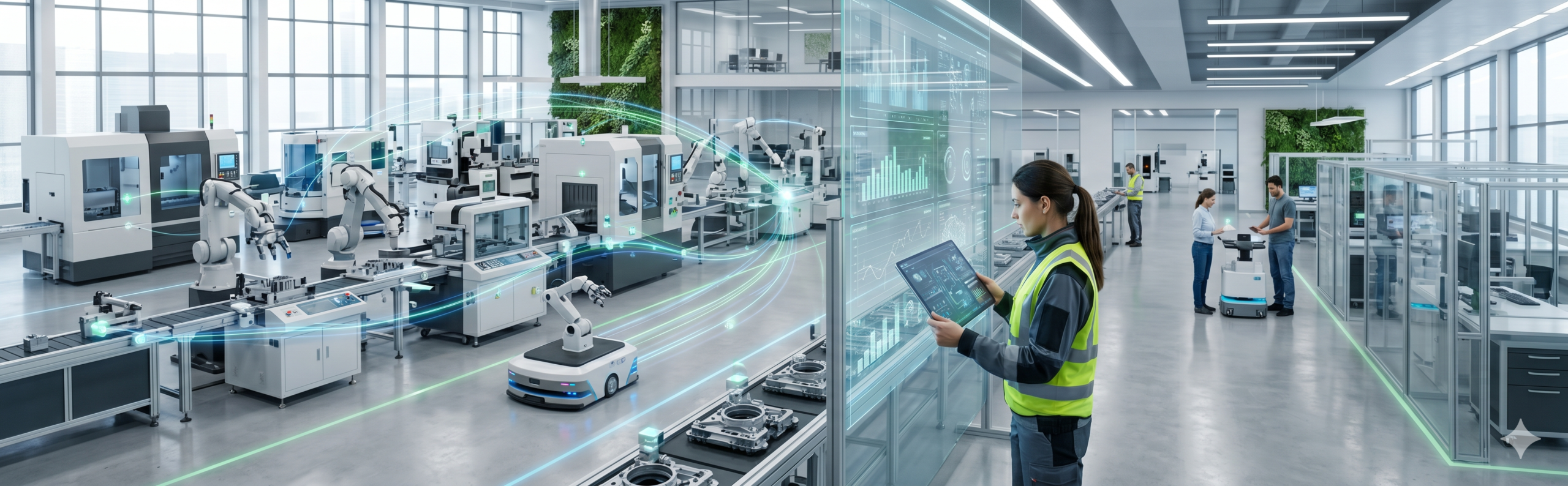
Industry 4.0 and Smart Manufacturing
The fourth industrial revolution is reshaping the manufacturing landscape, merging digital technologies with physical operations to unlock new levels of efficiency, agility, and innovation.
The industry 4.0 and Smart Manufacturing training module is designed to prepare operations leaders and technical teams to harness the power of advanced technologies—such as IoT, AI, big data analytics, and cyber-physical systems—for strategic advantage.
By integrating smart systems into production environments, organizations can enhance real-time decision-making, optimize resource utilization, and accelerate continuous improvement, positioning themselves at the forefront of operational excellence.
I4.0 and Smart Manufacturing Definitions
Industry 4.0: The digital transformation of manufacturing and value-creation processes, characterized by autonomous systems that use data to optimize production without human intervention.
- Smart Manufacturing: A specific application of Industry 4.0 principles where “intelligent” factories use data-driven insights to improve productivity, quality, and flexibility.
The Digital Twin Deep Dive
One of the most critical components of I4.0 is the Digital Twin.
Definition
A Digital Twin is a dynamic, virtual representation of a physical object or system. It is not just a 3D model; it is a live-sync replica fueled by real-time data.
Essential Factors for Creation
Sensors/IoT: To capture physical state (temperature, vibration, speed).
Connectivity: High-speed data transmission (5G, MQTT protocols).
Data Modeling: Physics-based or data-driven (ML) mathematical models.
Integration: Connection between ERP, MES, and the digital model.
Resource preparation
Hardware & Software
Hardware: Edge computing devices, Industrial IoT (IIoT) sensors, 5G private networks, and Cobots (Collaborative Robots).
Software: Manufacturing Execution Systems (MES), Product Lifecycle Management (PLM), and AI/ML Analytics platforms.
Human Resources & Up-skilling
The workforce must transition from “Operators” to “System Supervisors”:
Data Literacy: Ability to interpret dashboards and AI recommendations.
Mechatronics: Merging mechanical engineering with electronics and software.
Agile Management: Shifting from rigid production schedules to dynamic, customer-driven batches.
Proposed Training Curriculum
To ensure success, the following modules are recommended for management and technical teams:
Module 1: I4.0 Fundamentals: History, terminology, and the business case for change.
Module 2: The Connected Shop Floor: IoT protocols, PLC integration, and data architecture.
Module 3: Leveraging Digital Twins: Modeling, simulation, and predictive maintenance.
Module 4: Data-Driven Leadership: Using analytics for strategic decision-making and change management.
Executive Summary: Smart Manufacturing Strategy
A comprehensive blueprint for Industry 4.0 transition and Digital Twin integration.
Core Thesis
Industry 4.0 is not merely an incremental upgrade in automation (I3.0), but a paradigm shift toward autonomous cyber-physical systems. By bridging physical assets with real-time digital replicas (Digital Twins), organizations unlock predictive agility, reducing downtime by up to 30% and operational costs by 20%.
The Definition
Convergence of IT and OT via IoT, Big Data, and AI. A move from "Fixed Automation" to "Cognitive Manufacturing."
- Cyber-Physical Systems
- Horizontal/Vertical Integration
- Decentralized Decisions
The Digital Twin
A live-sync virtual model. Unlike static simulations, it utilizes two-way data streams for predictive maintenance.
- Real-time IoT Telemetry
- Lifecycle Data Management
- Predictive Forecasting
The Talent Shift
Moving from manual tasks to system supervision. Requires aggressive up-skilling in data literacy and mechatronics.
- AI-Human Collaboration
- Problem Solving Agility
- Digital-First Culture
The Value Proposition
Transitioning from I2.0/I3.0 to I4.0 creates value across four critical manufacturing axes. The chart below illustrates the shift in performance capability.
Transition Roadmap & Framework
Foundations
Sensors, PLC connectivity, and network infrastructure audit.
Connectivity
Data normalization via OPC-UA. Cloud integration.
Intelligence
Digital Twin pilot. Predictive analytics implementation.
Autonomy
Self-optimizing lines. AI-driven supply chain sync.
Training & HR Strategy
To support this transition, we propose a four-module professional curriculum focusing on Data Literacy, Digital Twin Operations, and Agility Management.
Technical Preparation
- • Hardware: High-bandwidth IoT sensors (5G/WiFi6)
- • Software: AI/ML Platforms & CAD Digital Modelers
- • Storage: Unified Data Lakes with edge computing
Human Capital Preparation
- • Re-skilling: Manual operators to System Supervisors
- • Up-skilling: Management data-driven decision making
- • Culture: Agile mindset for rapid production shifts