Other Essential RCA Tools
While the 7 QC and Six Sigma Tools are heavily quantitative, the following tools are primarily logical, qualitative, or engineering-based. They are essential for scoping problems, finding logical flaws, and engineering robust solutions.
5W1H
(Who, What, When, Where, Why, How)
Concept: A foundational questioning framework used to meticulously define a problem before any actual analysis begins.
Application: It prevents teams from "jumping to solutions." By answering who discovered it, what the exact defect is, when it occurred (date/shift), where it was found (on the part and in the facility), why it is a problem, and how many items are affected, the team establishes an airtight, factual Problem Statement.
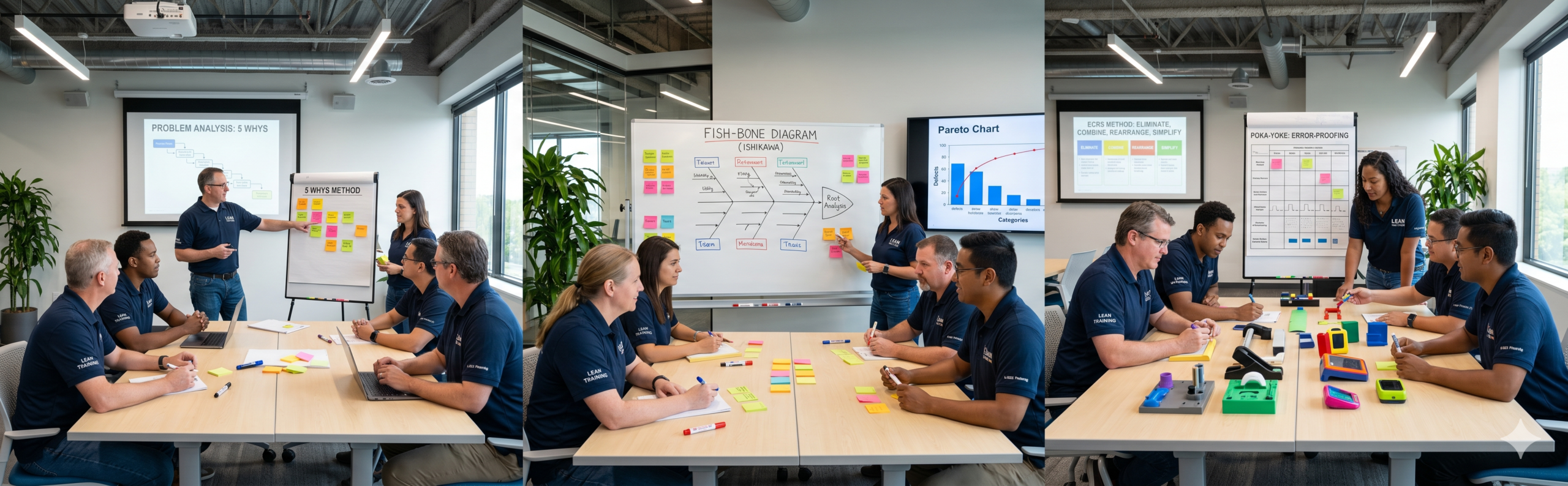
5 Whys
Concept: Pioneered by Sakichi Toyoda, this is an iterative interrogative technique used to peel back the layers of a problem.
Application: By asking "Why?" repeatedly (typically five times, though it could be more or less), investigators move past superficial symptoms (e.g., "the machine stopped") to reach the systemic root cause (e.g., "there is no preventative maintenance schedule for the oil filter"). The final answer dictates the permanent countermeasure.
ECRS
(Eliminate, Combine, Rearrange, Simplify)
Concept: A Lean process-optimization framework primarily used in the "Solve" phase once a root cause (often a wasteful or overly complex step) is identified.
Application: Teams attack the faulty process by asking: Can we Eliminate this step entirely? If not, can we Combine it with another step? Can we Rearrange the sequence to improve flow? Finally, can we Simplify the task to reduce cognitive load and the chance of human error?
Poka-Yoke
(Mistake-Proofing)
Concept: Developed by Shigeo Shingo, this involves designing a process or equipment so that a defect is physically or sequentially impossible to create.
Application: It is the ultimate tool for the "Sustain" phase. Instead of retraining an operator not to make a mistake (which is prone to failure), engineers design hard constraints. Examples include asymmetrical electrical plugs that only fit into an outlet one way, or a digital form that cannot be submitted if a mandatory field is blank.