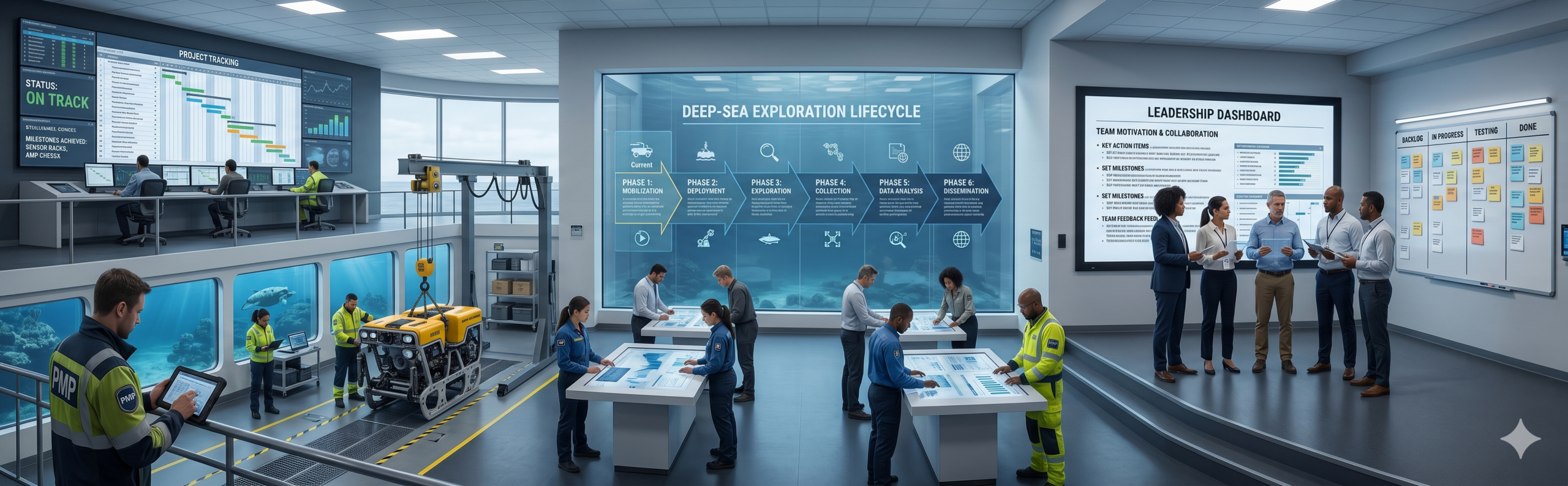
Project Management Professional
In today’s dynamic business environment, the ability to effectively manage projects is essential for achieving strategic objectives and maintaining a competitive edge. This project management course is designed to provide participants with the foundational principles, tools, and techniques needed to successfully lead projects from initiation to completion. Through a blend of theoretical insights and real-world applications, attendees will learn to plan, organize, execute, and deliver projects that align with organizational goals while meeting quality, time, and budget requirements.
Recommended Participants
Project Managers and Team Leaders
Individuals responsible for initiating, planning, executing, and closing projects. This includes both new and experienced project managers seeking to strengthen their skills in methodologies such as Waterfall, Agile, and hybrid approaches.
Operations Managers and Department Heads
Leaders who oversee multiple projects and need to ensure alignment with organizational goals, resource allocation, and performance tracking.
Process Improvement Specialists
Professionals involved in Lean, Six Sigma, or continuous improvement initiatives, who require structured project management tools to drive operational excellence.
Cross-Functional Team Members
Employees who participate in project teams across departments (e.g., R&D, logistics, IT, quality, production), supporting collaborative efforts and changing management.
New Project Management Professionals
Individuals aspiring to build foundational competence in project management principles, risk management, stakeholder engagement, and performance measurement.
Managers and Senior Leaders
Those who sponsor projects, set strategic direction, and require a clear understanding of project management best practices to ensure project alignment with business objectives.
Key Takeaways
Understanding of PM Methodologies
Participants will master foundational and advanced project management approaches, including Waterfall, Agile, and hybrid models, enabling them to select and apply the best methodology for each project scenario.
Effective Project Planning and Execution
Attendees will learn to define project scope, allocate resources, manage risks, engage stakeholders, and track progress, ensuring projects are delivered on time, within budget, and to quality standards.
Enhanced Collaboration and Communication
The training emphasizes cross-functional teamwork, stakeholder communication, and change management practices, equipping participants to foster collaboration and drive project success across departments.
Practical Tools and Techniques
Participants will gain hands-on experience with project tracking software, performance measurement tools, and best practices for managing project lifecycles, adapting to challenges, and ensuring continuous improvement.
Strategic Alignment and Operational Excellence
By integrating project management principles with organizational strategy, trainees will be prepared to lead projects that support operational excellence, drive innovation, and contribute to sustained business growth.
Confidence to Lead Projects
Whether new to project management or expanding their expertise, participants will leave the course ready to initiate, plan, execute, and close projects successfully, supporting organizational goals and delivering measurable results.
Professional Project Management
A strategic discipline for planning, executing, and closing projects. Explore the foundations, metrics, and systems required to drive organizational success.
1. Philosophy & Evolution
Project Management is not just about timelines; it's about balancing constraints to deliver value. This section explores the core "Iron Triangle" philosophy and the historical evolution of the discipline.
The Triple Constraint
Instructions: Click on Scope, Cost, or Time above to understand how they interact. Changing one inevitably affects the others.
Evolution of PPM
1910s: The Gantt Chart
Henry Gantt
Development of visual diagrams to schedule work, laying the groundwork for modern planning.
1950s: Critical Path (CPM) & PERT
Cold War Era
Mathematical algorithms for scheduling project activities used by the US Navy (Polaris) and DuPont.
1969: PMI Founded
Standardization
The Project Management Institute was born, leading to the eventual creation of the PMBOK Guide.
2001: Agile Manifesto
Software Revolution
Shift from rigid "Waterfall" to iterative, adaptive planning focusing on customer collaboration.
2. Project vs. Operations
A critical first step in PPM is distinguishing between "Projects" and "Routine Operations". This ensures the right management approach is applied.
Project
- Temporary: Has a defined start and end date.
- Unique: Creates a unique product, service, or result.
- Uncertainty: High risk and elaborative planning needed.
- Examples: Building a bridge, developing software, a marketing campaign.
Operations
- Ongoing: Continuous, repetitive cycle.
- Standardized: Produces the same output repeatedly.
- Stability: Low risk, focus on efficiency.
- Examples: Manufacturing assembly, Technical support, Billing processing.
3. Metrics & KPIs Dashboard
Professional management requires objective measurement. Interact with the dashboard below to explore key indices like SPI and CPI, and understand how to apply them to keep projects on track.
4. Project Lifecycle & Roles
Standard PPM follows a 5-phase lifecycle. Click on each phase to reveal the specific inputs, outputs, and the critical role the Project Manager plays during that stage.
Initiation
The start of the project. Defining the "Why" and getting authorization.
Key Deliverables
Project Charter, Stakeholder Register.
PM Role
The PM acts as a facilitator, identifying key stakeholders and working with the sponsor to define high-level scope and constraints. Focus is on alignment and authorization.
5. Building the PPM System
Implementing Professional Project Management is a change management project in itself. Follow this roadmap to build a robust system.
Goal: Understand current maturity level.
Evaluate existing processes. Are they ad-hoc or standardized? Define what "success" looks like for the PPM implementation (e.g., "Reduce project overruns by 20%").
Goal: Consistency.
Create the "PPM Toolkit": Project Charter templates, Risk Registers, Status Report formats, and Gantt chart guidelines. Don't overcomplicate; start with the essentials.
Goal: Proof of concept.
Select 1-2 small, low-risk projects to apply the new standards. Gather feedback from the team. Refine the templates and processes based on real-world usage.
Goal: Competence.
Train Project Managers and team members on the new system. Explain *why* it helps them, not just *how* to fill out forms. Launch the system organization-wide.
Goal: Optimization.
Establish a PMO (Project Management Office) or a governance body to review KPIs regularly. Update processes as the organization grows or market conditions change.